Your Competitors Are Collecting Reviews Every Day. Are You?
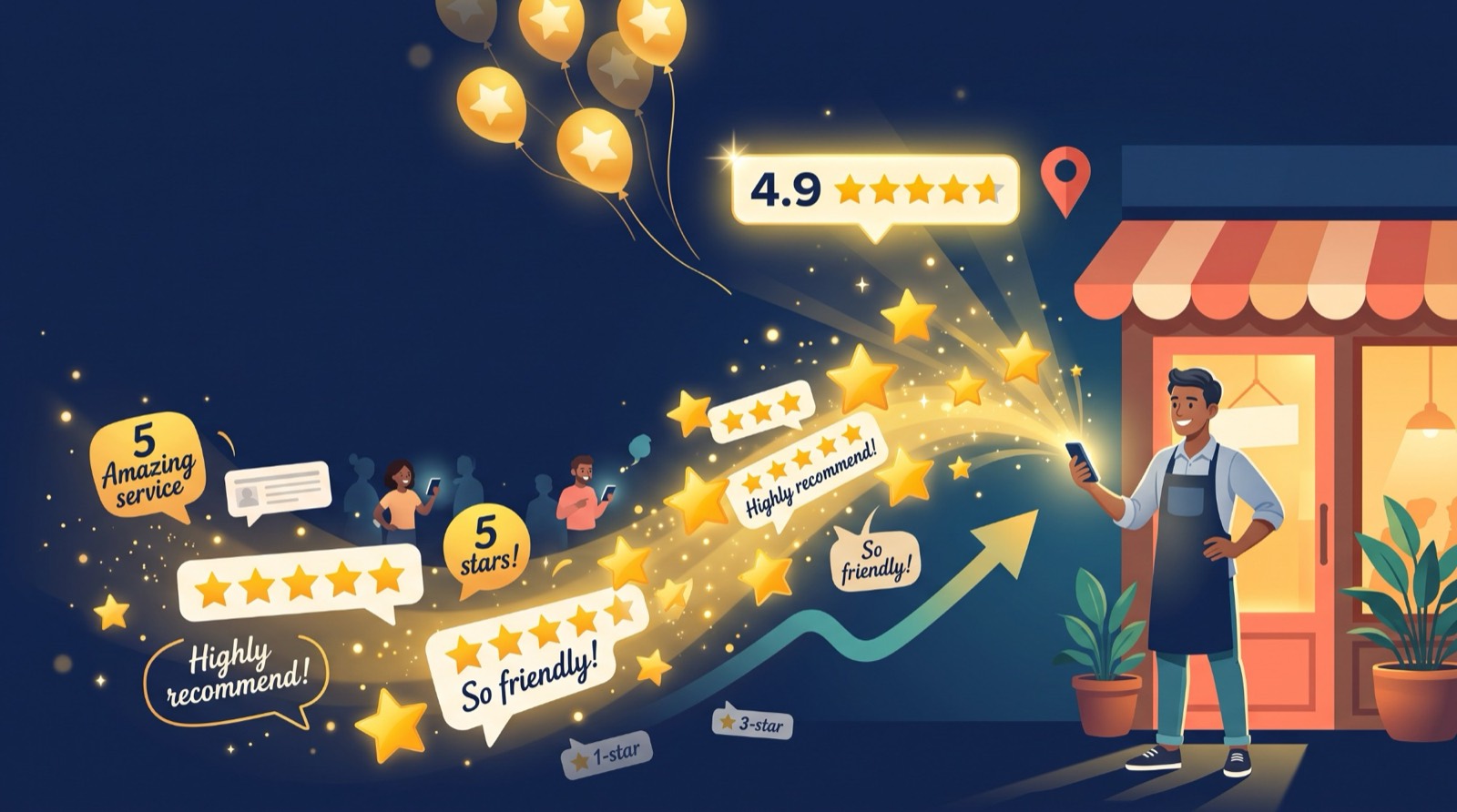
Let me start with a number that should change how you think about your business: the overwhelming majority of consumers read reviews before choosing a local business, and most of them trust those reviews as much as a personal recommendation from a friend. Read that again. Strangers on the internet carry the same persuasive weight as someone’s brother-in-law. That’s not a trend. It’s the permanent architecture of how customers make decisions now.
Reviews aren’t a nice-to-have marketing extra. They’re the mechanism by which your reputation is built, broadcast, and judged, 24 hours a day, in public, whether you participate or not. The businesses winning in local search aren’t necessarily the ones with the best products or the longest history. They’re the ones with the strongest review operations.
Here’s exactly how to build yours.
Ask Every Happy Customer, Every Time
The single biggest reason businesses have too few reviews isn’t that customers are unwilling. It’s that nobody asked.
Most satisfied customers won’t leave a review unprompted. Not because they don’t want to. Because it never occurs to them, and life gets in the way. The moment passes, the review never happens, and the mountain of social proof that could have been simply never forms.
So ask. Every happy customer. Every time. Make it part of your closing process, right alongside the final invoice or the follow-up call. Not as an awkward favor, but as a natural final step in doing business with you.
And yes, every time. Businesses that ask sporadically get sporadic reviews. Businesses that ask systematically get a steady stream, which matters more than you might think (more on that shortly).
Make It One Tap
Here’s where most businesses sabotage themselves: they send customers a message like “Please Google us and leave a review!” That’s a homework assignment. You’re asking someone to open Google, figure out how to find your profile, locate the review button, and figure out what to say. Every extra step kills conversion.
The fix is simple. Google gives you a direct review link (find it in your Business Profile dashboard), and you send that link by text message. One tap, review box opens, they type, done. Thirty seconds of their time.
Text, not email. Text messages get opened and acted on at dramatically higher rates than email, and the immediacy matters for what comes next.
Timing Is Everything
Ask within a day of finishing the job. Not a week later, not “when you get around to it.” Within a day.
Why? Because the good feeling is perishable. The customer who was thrilled yesterday is a customer who has mentally moved on by next week. Enthusiasm has a shelf life, and you’re asking them to spend effort on your behalf. The closer the request is to the moment of satisfaction (ideally the same day they saw the finished work or received the product), the higher your response rate will be.
Build the ask into your workflow so it happens automatically: job complete, invoice sent, follow-up text with the review link the next morning. Systemize it, and it stops depending on memory or motivation.
Reply to Every Review Within 24 to 48 Hours
This is where most businesses either shine or fail publicly, and your response strategy tells the world who you are.
Reply to every review (five stars, one star, everything in between) within 24 to 48 hours. Here’s why this matters beyond simple politeness:
First, Google sees engagement. Active profiles with owner responses send signals of a living, managed business, and that supports your visibility.
Second, and more importantly, prospective customers read your responses. Your replies aren’t really for the reviewer. They’re for the next hundred people deciding whether to call you. When someone sees that every review gets a thoughtful, timely response, they learn you’re a business that pays attention and stands behind its work. That alone closes sales.
Thank Your Five-Star Reviewers Like You Mean It
Don’t copy-paste “Thanks for the review!” That wastes the moment.
Thank five-star reviewers by name and mention the specific job: “Thanks, Maria! It was a pleasure handling the kitchen remodel on Maple Street. Glad the new layout is working for your family.”
This does three things: it shows the reviewer they’re not a number; it shows future readers that you actually remember your customers (implying excellent service); and it naturally reinforces the service and location keywords that help your local search relevance. Speaking of which...
Handle Negative Reviews Calmly: Own It, Move It Private
A negative review feels like a punch in the gut. I’ve seen business owners blow up publicly and turn one bad review into a reputation crisis. Don’t do that.
Here’s the playbook. Respond calmly, quickly, and professionally. Thank them for the feedback. Apologize for their experience without groveling or admitting fault you don’t believe exists. “I’m sorry we didn’t meet your expectations” works. Then invite them to contact you directly to make it right, with a name and phone number.
Two critical rules: never argue in public, and never offer compensation in the review thread (it reads as paying for silence and invites copycats). You acknowledge publicly, then take the resolution private. Often, a well-handled negative response impresses future readers more than a pile of five-star reviews. It’s proof of how you behave when things go wrong.
And occasionally, that unhappy customer, handled with grace, will update or remove the review. It happens more than you’d think.
Never Filter or Gate Your Reviews
Some businesses try to game the system: they send a survey first, and only customers who report being happy get funneled to the review link. This is called review gating, and it violates Google’s policies. More practically, it’s a false economy: a steady drip of filtered reviews looks unnatural, and if you’re caught, Google can wipe your reviews or suspend your profile entirely.
Ask everyone. Yes, this means you might occasionally get a three-star review. That’s fine. It’s honest, it’s credible, and a perfect wall of 5.0s actually reads as fake to savvy consumers. Mixed reviews with visible, calm responses build more trust than suspicious perfection.
The flip side: give unhappy customers a private path too. If someone had a bad experience, respond to their review and invite them to resolve it with you directly. Some people just want to be heard. Give them that channel before they vent in public.
Aim for a Steady Flow, Not One Big Push
This is a subtle point that trips up a lot of businesses: a hundred reviews added in one week, then nothing for six months, looks worse to Google than twenty reviews arriving consistently each month.
Steady, organic-looking growth signals a healthy, active business. One big push followed by silence can trigger scrutiny, or simply read as artificial to anyone browsing your profile. Build the ask into your routine so reviews arrive like rain, not like a flood.
It also keeps your average current. A review from last week outweighs a review from three years ago in both Google’s algorithm and customers’ minds.
Gently Encourage Service-and-Town Mentions
When you send that review link, it’s completely legitimate to add a line like “Feel free to mention the service we did and where you’re located. It helps other neighbors find us.” (Don’t script or dictate their review; just encourage specifics.)
Reviews that naturally mention the service (“fixed my AC”) and the town (“here in Plano”) are local SEO gold. They reinforce your relevance for those searches and give future readers exactly the concrete details that convert.
Show Off Your Best Reviews Everywhere
Your reviews shouldn’t live only on Google. Screenshot your best ones and put them on your website homepage. Share them on your social channels. Drop one into your email newsletter or signature. Feature them in your proposals.
Every piece of marketing you produce gets stronger when backed by real customer proof. A review wall on your website answering “why should I choose you?” before it’s even asked is worth more than any tagline you could write.
The Bottom Line
Reviews aren’t luck. They’re a system. Ask every happy customer, every time. Make it one tap via text link. Ask fast. Reply to everything within 48 hours. Thank five-star reviewers by name. Calmly own the negatives and take them private. Gate nothing. Keep the flow steady. Encourage specifics. Amplify your wins everywhere.
None of this costs money. It costs discipline, and the businesses that build the discipline own the local search results, the customer trust, and ultimately the revenue. Your competitors are either building this system or about to. The only question is whose reviews your next customer reads before they call.